
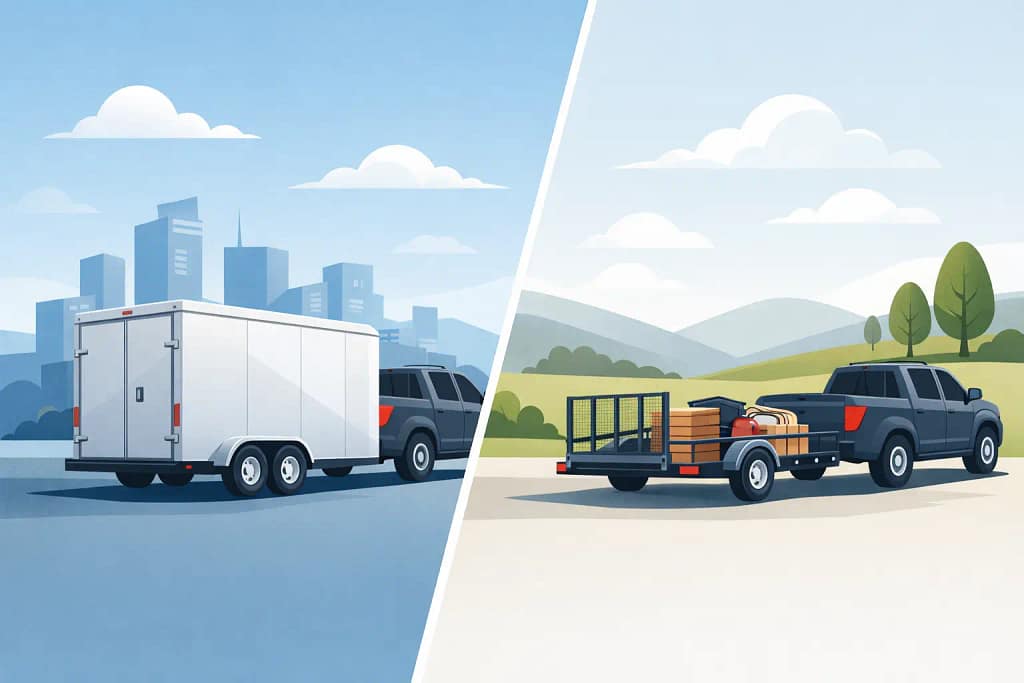
A lot can ride on one decision. If you are shipping a daily driver from Texas to Florida, an open trailer may be the practical choice. If you are moving a restored classic or a high-end vehicle you rarely take out in bad weather, the enclosed trailer vs open trailer question becomes much more important.
The right option depends on what you are shipping, how much protection you want, and how comfortable you are with the trade-off between price and exposure. For most customers, this is not about picking the “best” trailer in general. It is about choosing the right level of transport for one specific vehicle and one specific move.
Enclosed trailer vs open trailer: the core difference
An open trailer is the standard carrier most people picture when they think of auto transport. Vehicles are loaded onto a multi-car trailer and transported exposed to normal road and weather conditions. This is the most common and most cost-effective shipping method in the US.
An enclosed trailer carries vehicles inside a covered transport unit. The vehicle is shielded from rain, road debris, sun exposure, and outside visibility during transit. Enclosed shipping usually moves fewer vehicles at a time and costs more, but it offers a higher level of protection.
That basic difference affects nearly everything else, including price, availability, transit timing, and which types of vehicles are a strong fit for each option.
When an open trailer makes the most sense
For standard vehicles, open transport is often the right answer. It is widely available, efficient, and typically the most affordable way to move a car across state lines. If you are shipping a family SUV, commuter sedan, pickup truck, or leased vehicle, open transport usually gives you the value you need without paying for protection you may not require.
Open carriers are also more common on major shipping routes. That can make scheduling easier, especially if you need faster pickup options or are working around a relocation deadline. Because more open carriers operate nationwide, there is often more flexibility in matching your shipment with a vetted driver.
Exposure is the trade-off. Your vehicle will be transported safely, but it will not be isolated from dust, rain, or normal road grime. That does not mean damage is expected. It means the car arrives having traveled the same highways as every other vehicle on the road, just on a carrier instead of under its own power.
For many customers, that is a perfectly reasonable trade. If the vehicle is used regularly and does not require specialized handling, open transport is usually the practical choice.
When an enclosed trailer is worth the extra cost
Enclosed transport is built for customers who want a stronger layer of protection or are moving a vehicle that carries higher value, financial or personal. That includes exotic cars, collector vehicles, antiques, custom builds, luxury models, and motorcycles that need more controlled handling.
If the paint is delicate, the body kit sits low, or the vehicle has recently been restored, enclosed shipping can make a lot of sense. The same goes for cars heading to auctions, shows, dealerships, or private buyers where condition matters down to the smallest detail.
There is also a peace-of-mind factor. Some owners simply do not want their vehicle exposed during a long-distance move. That is especially true when the vehicle is hard to replace, heavily customized, or emotionally significant. Paying more for enclosed transport is often less about overprotecting the car and more about reducing avoidable risk.
In those cases, the extra cost is easier to justify.
Cost differences and what drives them
Price is usually the first thing people compare, and the gap can be significant. Open transport costs less because the carrier can move more vehicles at one time and the equipment is more common. Enclosed transport costs more because capacity is lower, demand is more specialized, and the protection level is higher.
But cost is not just about the trailer type. Distance, route popularity, vehicle size, season, pickup flexibility, and whether the car runs all affect the final rate. A short enclosed shipment on a busy route may be less expensive than people expect, while a last-minute open shipment to a remote area can still carry a premium.
The better way to think about price is this: open transport is usually the best fit when budget is the priority, and enclosed transport is usually the best fit when condition protection is the priority. Neither choice is automatically right or wrong. It depends on what you are trying to protect most – your budget, your timeline, or the vehicle itself.
Protection, risk, and realistic expectations
Some buyers hear “open” and assume it is unsafe. That is not accurate. Open transport is the industry standard for a reason. It is widely used, reliable, and suitable for the majority of everyday vehicles. Cars are secured professionally, carriers are insured, and the process is routine.
At the same time, enclosed shipping does offer a higher degree of protection from outside conditions. That matters most when even minor cosmetic exposure would be frustrating or expensive. If a vehicle has rare trim, flawless paint, or show-level presentation, enclosed transport helps protect that condition in a way open shipping cannot.
It also helps to be realistic. Enclosed transport reduces exposure, but it does not eliminate every possibility of delay or issue. Weather, route conditions, and scheduling still affect all transport. The difference is that enclosed service gives your vehicle a more controlled environment while it is on the road.
Availability and timing can change your decision
One of the less obvious parts of the enclosed trailer vs open trailer decision is carrier availability. Open carriers are more common, so pickup windows are often easier to secure. If you need to move quickly, that matters.
Enclosed carriers are more limited. On some routes, especially less common ones, that can mean longer lead times or fewer scheduling options. For customers moving a specialty vehicle, planning ahead is smart. Waiting until the last minute may narrow your options or raise the cost.
This does not mean enclosed shipping is slow. It means it is more specialized. If timing is tight and the vehicle does not need extra protection, open transport may give you more flexibility. If the vehicle does need enclosed service, booking early usually solves the scheduling issue.
Which vehicles belong in each category
Most daily-use vehicles ship well on open carriers. That includes sedans, crossovers, vans, and standard trucks. If the vehicle is driven regularly, has normal ground clearance, and does not require special handling, open transport is often the most sensible route.
Enclosed transport is a stronger fit for luxury cars, classics, antiques, exotics, rare collectibles, low-clearance sports cars, and custom vehicles with specialty paint or parts. It is also a good choice for motorcycles and for buyers receiving a high-value vehicle they purchased out of state.
Sometimes the answer is less about the vehicle category and more about owner preference. A newer luxury SUV may ship fine on an open carrier, but an owner may still choose enclosed because they want maximum protection. That is valid. Good transport planning is not about forcing every vehicle into the cheapest lane. It is about matching the service to the customer’s comfort level.
How to choose with confidence
Start with the value and condition of the vehicle. Then consider the route, your budget, and how much exposure you are willing to accept. If you would be upset by road dust, weather contact, or visible transit exposure, enclosed is probably the better fit. If the car is a standard vehicle and your main goal is dependable shipping at a fair rate, open is usually the smart move.
It also helps to work with a transport team that gives clear answers instead of pushing one option across the board. A good shipping partner will explain the trade-offs, set realistic expectations, and provide an upfront quote with zero surprises. That matters just as much as the trailer type.
At Pro Auto Carriers, customers often ask which option we would choose ourselves. The honest answer is simple: for most everyday vehicles, open transport does the job well. For high-value, sensitive, or hard-to-replace vehicles, enclosed transport is worth serious consideration.
The best shipping choice is the one that fits your vehicle, your priorities, and your comfort level before the truck ever arrives.